
Supporting less able students in A Level Geography
Naomi Andersson shares her wealth of experience in supporting less able students in A Level geography to maximise their potential

Hot tips for supporting less able students in A Level Geography
Base line testing - for me this is enrolment homework, we are a sixth form college, and have around 8 regular feeder schools from the surrounding towns and villages. We welcome students who have moved to the area from all over the UK and abroad. Students come to us having been homeschooled, or having completed their GCSEs in independent schools. The region could be described as rural deprived meets rural middle class, some have little to no experience of places beyond the county boundary, their lives are lived hyper locally and online, a significant number attract travel bursaries and free school meals. Others have travelled extensively, have worldly experiences, have skiing trips and went on international trips with school. My approach is to champion both, to celebrate the deep attachment to place, to explore place meaning and explain process and landform of place at the hyperlocal level while also creating those linkages to wider world, globalisation and geopolitics. This really gets the light bulbs flashing over their heads. Referencing Professor Danny Darling’s teachings about working class geographies has helped me to develop my own flavour of fact based, reality in human geographies.
Enrolment homework is a great leveller. I use it to assess the Geographical knowledge, skills and behaviours I will need in the classroom. For the students I measure their ability to research and report back, the ability to geo reference a location, to answer a series of questions in full by a deadline. Here are my questions:
Have a go, just a short sentence answer is all that is needed.
Explain how perceptions of place might vary between people of different ages?
How might you measure differences in socio economic status in a place?
What is a flagship development? Can you give an example?
What is the six figure grid reference for Ludlow College, Castle Square?
What evidence is there in Ludlow of the last glacial maximum?
Identify the top 10 volcanic eruptions of all time.
What is the current atmospheric CO2 level in parts per million (ppm)
What is your favourite glacial landform?
The students then complete this metacognition exercise:
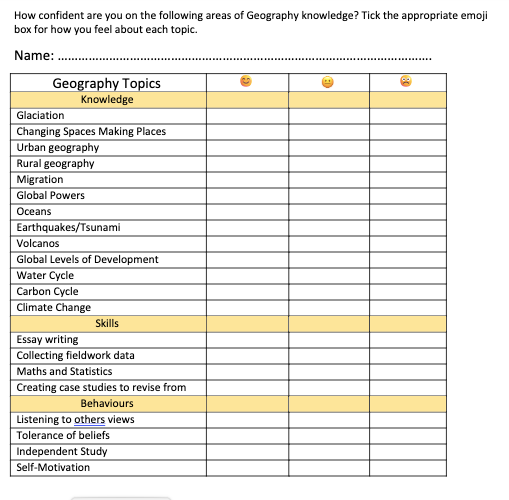
This exercise requires virtually no marking from me, it shows me their ability to look something up, their stamina for a few questions, their own perception of their knowledge in a quick snapshot.
2. Knowledge - In order to support a less able student with knowledge gaps, I scaffold every lesson, creating my lesson planning guided by the specification points and awarding body’s delivery guides. For each subtopic I will go back to trusty old Bloom’s Taxonomy and start with ‘define’ and move through over time to explain, analyse and evaluate through my activities.
One of the fastest ways to help a student struggling with Geography is to teach them vocabulary, all my topics start with key terms (many have never heard before) on the whiteboard, we will discuss what we know, what we don’t. We practice pronouncing the words, spelling the words, using the words in a sentence. Students are encouraged to keep glossaries. It amazes me how students may avoid the use of a word like “aseismic” when its use will elevate an answer in an assessment. Repeat repeat repeat the value of using these key terms and phrases. Many of my end of topic activities will involve taboo or games reusing these words in pairs and small groups. My revision resources will highlight this same language in question form.
I provide blank glossaries (lists of key terms in a table with a gap for them to fill in) for water and carbon only, students are expected to make and maintain their own. I never provide completed glossaries, in my view even the weakest student can look up a word or ask me for an explanation. I expect to see evidence of these in folder check weeks and occasionally in homework tasks as an extension, to encourage independent learning.
Reading the textbook, regardless of spec (I’ve taught both Edexcel and OCR) I set a weekly reading and questions task from the homework. Around 20-30 minutes reading (or listening to recordings/immersive e-reader) and the subchapter questions in the book, a short comprehension task. This repetitive habit is a powerful tool for the weaker learner, I’ve watched target grade D-C students exceed their targets through diligent weekly effort outside the classroom. The investment for me is in creating 2 years of weekly homework tasks aligned roughly to the classroom learning but I don’t worry too much if its in front or behind us, it actually works like flipped learning or revision either way. Then marking is a quick glance on MS Teams through the scanned handwritten answers or typed submissions, looking for common group errors, non completion or misconceptions. These are addressed in a quick copy and paste feedback alongside personalised encouragement.
3. Skills - Interestingly, it is sometimes the weaker students who are better with skills, or perhaps handle learning a skill in a more positive way. So from teaching statistics with gapped handouts, modelled on the board by me, with the language explained, the context and point of doing this explained and repeated, then re modelled and then let loose for chaos and supported with humour we find the flow. Where diverse abilities are suddenly all engaged, working as teams and discussing what reject the null really means.
GIS Skills require time and energy, so many students struggle with IT skills, find MS Teams hard to handle and ArcGIS online is my favoured tool. I do however start with Google and StreetView in Term 1, then Google Earth Pro (historic view) in Term 2, we meet ArcGISonline after glaciation fieldwork around Easter. I will have students studying Computer Science, and students who have absolutely no idea how to navigate a menu. We start with changing symbols, geolocating, then we use Survey 123 to create some data and import it. We learn to measure polygons, some might want to explore drive times. Each of these tools starts with a simple worksheet of activities, to lead a student through the topic of study using a range of tools and menus.
When preparing for NEA I allow more free/independent time to get to know the tools, we’ve had support from ESRI online, Worcester and Aberystwyth Universities in to help us with activities and students have attended GA schools events in the Midlands to see the applications of GIS in the workplace.
I believe the most valuable geographical skills are enquiry - having the freedom to think critically and ask a question and process - to see places, landscapes, concepts as systems. If you can impart those with all students, but particularly weaker students you give them the confidence to infer and connect in ways they couldn’t before.
4. Mastery - a Geoff Petty technique that has transformed my teaching, a welcome break during heavy theory, or a good starter or plenary these are possibly the most powerful tools in my armoury. 5 low-stakes, short answer questions on topics past and present. Aimed at improving recall of vocabulary, process, place, facts, stats, concepts, cycles, these questions are asked in a quick-fire manner, students record on small scraps of paper that live under pen pots dotted around the desks. I read the questions, I give the answers and then ask who got 5, 4, 3 and who needs to go and re-read or come ask me for help after this lesson. There is no consequence nor disciplinary for failing, there is no calling out, nor shaming for not knowing. There is no high praise for the 5 every time crowd either, just encouragement that if you don’t know the answers you aren’t learning the stuff that you will need to know in the exam. By spacing these questions on topics from 2-3 weeks ago you can show the forgetting curve in action, explain the need for A Level behaviours of independent study, note write ups, mind mapping, and the shift from GCSE cramming to A Level long game learning.
5. Revision - I use blank A3 knowledge organisers with the spec points laid out showing an entire topic on a page. Case studies and key terms boxes lay waiting to be filled in. These prove to be very popular. The fear of having missed something when you aren’t secure in your knowledge can be crippling. These resources enable a weak student to make a start, identify gaps and realise the process of learning to pass an assessment and start to understand how exam questions are created.
In addition, we play games in the classroom based on the ’30 days’ revision ideas. I’ve created 30 questions for each and every A Level topic over the years and we put these on the board, the students have one in front and we play pick a question, pick a person, in small groups.
The options are:
Answer the question
Partially answer the question and ask for help
Ask the audience
Question the questioner
Ask the teacher
Ask for time to look it up
Phone a friend (conceptually - in the classroom)
You’ll notice that ‘I don’t know’ is not an option, and students learn that its OK to have some but perhaps not secure understanding, we make time to allow students to write notes/to do lists during these sessions. If we really struggle we can re-teach, re- learn too.
Parents, guardians and supporters and Consultation Evenings - I use these more as a platform for what is expected and the support needed from home than for a report on how a student is performing.
e.g. homework is set every week. You’ve completed 8/8 or 4/8 for the last half term. It’s set every week, those that don’t do it don’t do very well in exams. Doing it is the win here for the weaker student.
e.g attendance. Students who attend less get lower grades, your attendance is 85%, you are often away on Fridays, what can we do to support or change this? Your attendance is affecting how well you do at college. Identify some motivations for achieving together.
And finally, and perhaps controversially (I doubt my CMT would agree with me here), in my class there is no disappointment in gaining an E or a D, for some to get a score on the board is a massive win when you consider their home lives and educational backgrounds, bad days at the office during exam weeks, the trauma, the illnesses, the anxieties. I'm good with a pass. For me, it's the turning up, the taking part, the widening of horizons and having a go that stays with young people, particularly for those who aren’t going off to Uni to study it further. A very wise colleague coined the phrase “unconditional compassionate regard”, that is what we need for the weakest of students. It's a philosophy I stand by.